Computer science for everyone!

Really? For everyone?

I think I agree with the idea of teaching computer science in every Utah school as presented in a recent Silicon Slopes post; however, I wasn’t sure what that means.

What would universal computer science education opportunities for K-12 students in Utah include? Afterall, computer science is a broad discipline which can cover topics as:

Algorithms and Computational Geometry
Architecture and VLSI
Data, Databases and Information Management
Formal Methods and Verification
Graphics and Animation
Image Analysis
Human-Computer Interaction
Machine Learning and Natural Language Processing
Networking, Embedded Systems, and Operating Systems
Parallel Computing
Programming Languages and Compilers
Robotics
Scientific Computing
Visualization

Which of these topics are appropriate for K—12? (I compiled the list above from the University of Utah’s department of computer science website.)

I would assert that, currently, only a small fraction of K—12 students participate in Computer Science as defined by the topics above. Robotics is the most obvious example where we see activity, but because of student interest and not part of a broader curriculum. Robotics is an interesting example because it encompasses multiple aspects of computer science (as defined above) including human-computer interaction, programming, networking, and embedded systems. The depth of knowledge needed for each of these will depend on the project; however, it is an example where teachers can integrate multiple projects into the K—12 curriculum.

But would an area like robotics be helpful to all students?

Perhaps a better idea is to add a “computer science” learning objective to the current core curriculum. What would be possible in science courses today?

Biology, Chemistry, Physics, could all incorporate areas such as data visualization and basic scientific computing (i.e., using computers to solve problems), but working with programming languages, compilers, parallel computing, formal verification?

Before jumping on the computer science bandwagon, we need to ask a straightforward question: What knowledge do want students to demonstrate upon graduation from high school?

My observation is that students receive very little formal training on what we would probably claim as necessary computer skills: writing using a word processor, working with spreadsheets and databases, etc. How much of the Microsoft Office (or LibreOffice or GoogleDocs or “insert your favorite, regular computer tasks here”) should students know when they leave high school? These skills are not computer science, but they are useful tools to have in one’s toolbelt.

Do schools offer “typing?” During my first university teaching position, I asked students to type their reports. One student told me directly that she went to a private school and didn’t “type.” (In a voice indicating that she believed typing was below her—this statement was made the late 90s, so computers were not ubiquitous as they are today.) To this day, I am happy I took typing in high school; it has made work using a keyboard easier. Would this be considered an essential skill needed for computer science? Typing, as taught before typewriters became extinct, was targeted towards vocational workers; has it risen in status? I think the proper term today is “keyboarding;” however, is it still treated as a vocational course? Probably so.

If we advocate teaching computer science in K-12 classrooms, we need to define what skills we want students to master accurately. These skills are not going to be determined by the computer science departments; they’re going to be set by the disciplines who have adopted technology as part of their work. In math, students should have the opportunity to explore mathematical equations by defining the function, ranges, etc., as they explore new concepts, but only after understanding how to work through the problems manually. Biology, chemistry, and physics can all implement data analysis, scientific computing, visualization, and other topics into the classroom, but it can’t be at the expense of building a basic understanding of the underlying principles. Building a solid foundation is critical before jumping into complex problems that need the tools of computer science.

I hope someone is carefully thinking this through.

What would be the cost of public financed college?

For the taxpayers of Utah, 1% —1.5% is my best guess.

Bernie Sanders promoted “free college” during the 2016 Democratic Primaries; unfortunately, Senator Sanders wasn’t able to articulate that message into a winning strategy. Democrats, in general, are failing to capitalize on an issue that should resonate with the majority of Americans.

Who is concerned about college cost? If it’s not everybody, it should be. There are nearly 120,000 students enrolled in Utah’s colleges and universities. With approximately 900,000 households, we can estimate that more than 1 in 10 households have a college student and are directly impacted by the cost of college. I would wager that families with school-age children (K-12) are equally concerned. Add grandparents to the equation,  what percentage of Utah households are concerned? You and all these people — hundreds of thousands if not a one to two million — who want the next generation to succeed.

If the cost of college were negligible, wouldn’t the majority of these people (parents, grandparents, aunts, uncles, neighbors) consider college a worthwhile option?

If the definition of a public institution is one that receives the majority of its funding from the public, then the state of Utah is on the verge of losing its public institutions of higher education (Table 1).

tution and tax funds per utah higher ed TABLE 1

So, I want to pose a question: What would it cost to fund public higher education fully?

In Utah, the total FY 2016 budget was $14.2 billion; 12% of that was for Higher Education — approximately $1.7 billion. This amount is the Operating and Capital Budget. Students currently spend roughly $680 million in tuition and fees (Table 2). To fully fund higher education would require increasing the amount of money spent on higher education by 40% — but this is less than a 5% increase in the total state budget.

tution and tax funds per utah higher ed TABLE 2

What would this mean to taxpayers? Census estimates show Utah having just over 900 thousand households in 2016; the median household income was $61,000. A back-of-the-envelope calculation would have the typical family pay less than $800 per year which would amount to a 1% — 1.5% increase in the income tax rate (currently at 5%). If you are a parent who wants their child to go to college, this is a bargain. For those of us whose children will be out of college, it’s a price I’d be willing to pay to provide qualified students the opportunity to succeed along a path with known financial benefits.

Is this a reasonable estimate? (It’s a start.)
Is this feasible? (It seems possible to me.)

It’s not free college — taxpayers will pay the bill, but it’s the ideal of public education and investment in our state we should consider.

First-year Environmental Chemistry After 30 Years

As both of my daughters are now in their first year of college and having a Ph.D. in Chemistry, there is an assumption that you can be a helpful resource with basic chemistry. (For the record, this is not a safe assumption.)

In my efforts to be helpful, I pulled out my first-year Chemistry text. In the spring of 1987 I was completing my second semester of Chemistry, and as I reviewed the old class syllabus, I noticed that Environmental Chemistry was one of the chapters covered. In thinking about the course, I specifically remember Professor John Hubbard making the analogy that the environment was like a buffer. I don’t recall the particular system, but the analogy applies to both the atmosphere and oceans.

The definition of a buffer solution is pretty simple; it’s a solution that resists change in pH upon addition of either an acid or a base. In a broader sesnse, we use the term to describe any system that resists change upon addition of a compound that would alter the equilibrium of a system.

A single section of the chapter discussed the topics of acid rain, photochemical smog, carbon monoxide, and climate. Within this text, a single paragraph summarized the role of carbon dioxide and its role in maintaining surface temperatures. Within this one paragraph, there was the warning “If the calculated effect of doubling of CO2 level on the surface temperature is correct, this means that the earth’s temperature will be 3 degrees C higher within 70 years.” (Chemistry: The Central Science, T. Brown and H.E. LeMay, Jr., 3rd ed., Prentice-Hall, Englewood Cliffs, 1985, p. 393.) Current CO2 levels are 405 ppm (parts per million) compared to 330 ppm as referenced in the 1985 text.
(https://www.scientificamerican.com/article/atmospheric-carbon-dioxide-hits-record-levels/) A 23% increase.

I was curious… can I see this prediction in data from my home locale of Salt Lake City, Utah?

I pulled a simple data set from NOAA’s website–annual averages from 1948 through 2016. Here are the data and a simple analysis.

SLC annual temperatues 1948-2016Annual Average Temperature (°F) for Salt Lake City, UT
(1948⎯2016)

It’s pretty remarkable. Over the past 69 years, the average annual temperature is increasing at a rate of 0.05 °F/year (0.028 °C/year).

The average (mean) value over this period is 52.4 °F (11.33 °C) with a 95% lower and upper confidence limits of 52.0 °F (11.33 °C) and 52.8 °F (11.54 °C), respectively. The top and bottom traces on the graph show the 95% prediction intervals.

So what does this mean? If we look at temperatures from 2012 through 2016, they all fall inside the 95% prediction intervals. So, no problem! (Right?)

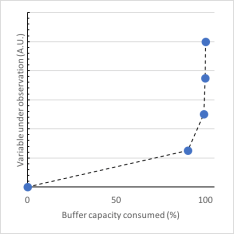
But go back to the initial premise that the atmosphere is a buffer, when will we know that we’ve exceeded the “buffer capacity” for CO2?

buffer example rev00An example of a buffer curve showing the variable
under observation versus percent completion.

And that’s the problem, we don’t know how much of the buffering capacity we’ve consumed, and we probably won’t know where we are on the curve until after we’ve reached a tipping point, and temperatures accelerate beyond the slow, apparently linear trend we observe today.

Why should we fund research? It is investment in individuals that pays off.

What’s the ROI to the nation? A quick, back-of-the-envelope estimation (okay… a quick spreadsheet estimation) shows the internal rate of return to be positive. The short-term cost of supporting graduate students has long term benefits.

image (2)Figure 1. Estimated salary from age 22 to 59 for a hypothetical worker.


image (3)Figure 2. The internal rate of return on supporting a graduate student for six years in this example is 3.6%.

As a democracy, we have a unique opportunity to decide what is important. What “Great” ideas can we as a nation support that as individuals we could never achieve.

Most people today are familiar with an MRI; however, most people do not know the technology is based on Nuclear Magnetic Resonance (NMR). The fundamental physics of NMR was first worked out in the 1930s. Development of the technique continued after World War II, but it wasn’t until 1977 that the first MRI was performed on a person. (https://www.aps.org/publications/apsnews/200607/history.cfm)

That’s a three to four-decade process from lab to commercialization. For every mainstream technology our society uses today, there is a similar story.

How many graduate students worked on projects during the 30+ years of development of the final product? Buried inside the major headlines are thousands of “little” stories. Stories of our nation’s commitment to supporting researchers and their basic research.

Those who pursue advanced degrees in science and engineering – financially supported by our national government – provide the foundation for companies who take an idea to market; industries (semiconductor, pharmaceutical, medical device, energy) aren’t building widgets anymore, they’re building vast databases of knowledge that will result in physical products. The jobs needed to create those physical products will rely on highly automated systems and any tasks that require low skill labor is going to be outsourced or marginalized. As a Democracy, we can support the creation of knowledge and develop skills to improve our quality of life or fall behind countries making that investment. As a bonus, it makes financial sense as well.