Grading on a curve

Grading on a curve. The term gets thrown around a lot, especially on a university campus; however, it has meaning beyond academics.

Students believe grading on a curve helps those at the lower end of the distribution.

In academics, it is a measure of student ability compared to their peers so when faculty grade an exam they don’t necessarily care about the absolute grade, but the distribution of scores. For the record, grading on a curve is hard work. You have to calculate the class statistics—mean, standard deviation, etc.—and then determine how many points needs to be added to each test to move the curve to the desired point. (In reality, “scaling” is more often used with the same number of points being added to all scores to change the numerator, or questions “thrown out” to modify the denominator.) I graded on a curve—students on the low end of the curve loved it… students on the high end of the curve hated it because what usually happened is that it helped low scoring students more than it helped those at the top. (For the record, I often felt the need for grading on a curve was due to my inability to craft a good test, not just a reflection on the students abilities.)

But, we are also graded on a curve professionally, and that grade is most often expressed in dollars.

Where is this going? When I take the time to reflect, I ask myself three things:

  1. Do I like what I am doing?
  2. Am I being compensated fairly?
  3. If number two is no, what do I need to change?

Do I Like what I’m doing? Sometimes, when the answer to question one was a “yes,” I stopped. This decision may not have been right financially, after all, if you are treating employment as Me, Inc., the goal should be to maximize shareholder value (being a shareholder of one). Trading time and talents for money should dictate finding the maximum return on those valuable commodities. For the majority of my career, the answer has been a “yes, but…” which leads to question two.

Am I being compensated fairly? The problem is finding the right metric. For most of my professional career, I have used the American Chemical Society (ACS) Salary Calculator. This tool is a member only resource I have found very useful. New graduates and experienced professionals can use the online tool and it covers academic and non-academic positions, degree type, the degree year, geographic location, and additional job details. The output is not just the median but also a breakdown by centiles. Today, Glassdoor.com, LinkedIn.com, and other online services are providing basic information (usually, a salary range) or an estimation of your market value.

Is the information accurate? The ACS Salary Calculator is the most direct as it uses data from their annual employment survey using a large member base. From a limited sampling of positions for which I know the salary ranges, Glassdoor.com and LinkedIn.com offer useful information to make comparisons. So this rephrases the question to “where am I on the curve?”

I’ve taken comfort at being “above the mean”—or median. Except, of course, those times when I stopped at question one because the gig was just too exciting to worry about money. (I remember my father making the following statement to my musician brother when he stated he had a “gig:” “If you’re getting paid, it’s not a gig, it’s a job.” (Gigs can be a lot of fun if you don’t need the money.)

Being used by an organization is not a good feeling, but if you’re on the low-side of the salary curve, what can you do?

What do I need to change? Unlike a test, in the work world, you can’t rely on the grader to modify the curve. You can ask for a raise and attempt to justify the change based on your performance against the curve, but I can’t think if a case where this worked. The most direct way is getting an offer to work at a similar job for a new company for a higher salary. Again, based on a small sample of managers I’ve discussed this issue with, most are not willing to negotiate based on a competing offer. If you are ready to change companies, it’s a good way to move on the curve. But what if you like the company where you work?

Increasing your capabilities is another way to move on the curve. Are there opportunities at work to learn new skills that will make you more productive or allow you to contribute elsewhere in the group or organization? If not, what can you do outside of work? I have used a fair amount of personal time for professional development. The effort might not lead to an immediate improvement; however, building new skills and solving significant problems should be rewarded. If it’s not, look for another gig—I mean job.

Always ask questions. As a successful scientist or engineer or (insert your field here), what do I need to learn to manage projects or teams effectively? How can I better support my company (business unit) to satisfy our customers, both internal and external?

Which curve are you on? How do you move on the current curve or switch to the next curve?

Of course, you can also jump to a new curve. You may be in the 90% percentile for engineers in the world-wide-widget industry, but if the widget industry pays comparatively low salaries, it’s very likely you won’t be able to move much further on the curve. Unless your skills are directly transferable, you’ll probably need to do something that puts you on a different curve.

Changing where you’re at on any curve, or changing curves, takes time, effort and usually a monetary investment.

  • The time commitment can be substantial: one, two or even 10 years!
  • It takes real effort. It’s much easier to go golfing or skiing on the weekend than to learn skills you’ll use only at work.
  • Funding may be a significant obstacle, but with planning or finding “next best alternatives,” progress is possible.

Science Education: 1990 to 2017

In 1990, Shelia Tobias published “They’re Not Dumb, They’re Different: Stalking the Second Tier.” Billed as “An occasional paper on neglected problems in science education,” the book was published by Research Corporation, a foundation for the advancement of science. I vaguely remember reading the book around 1998 at the beginning of my teaching career; however, after deciding to leave academics, there was no need to think about the topic. Until last year, when I met the author at a national meeting focused on Professional Science Masters programs, and I decided it would be interesting to revisit the book.

Anyone who is preparing students for college should read this book – particularly, if your students are in the typical “college prep” track course work in calculus, physics, chemistry, etc. The book not only attempts to address why able students don’t pursue careers in science but also why students leave the sciences and pursue other studies.

The methodology was unique with seven recent, non–science graduates hired to “seriously audit” first–year chemistry and physics courses. The practices described by the participants are in line with my experiences as an undergraduate science major, with my observations as a Teaching Assistant in graduate school, and as faculty at a state university. As I started my teaching career 20–years ago, making changes to the status quo was not overly encouraged and this was one factor in my decision to leave academics.

So what’s happening today?

Unfortunately, in some areas, not much has changed. Although my impression is akin to someone looking through a single, transparent pane in a broad framework of stained glass, discussions with both my daughters during their first-year chemistry courses indicate the primary focus is still on problem-solving. To be successful, you need to recognize the problem and have the right tools in hand to solve it; asking “why” is less important than asking “how.” Why is it important for citizens to understand science? Why do scientists challenge the status quo? Why is the scientific method important? However, on a positive note, the uber–competitive environments of the past seem less so, and student collaboration is encouraged. (Maybe, over encouraged.) Additionally, the number Department, University, and online resources allow students to learn the topic in ways that better fit their learning style, although making students aware of these resources is difficult.

That college students from 1990 were turned off by the teaching pedagogy was my main take away from the reading. The importance of strong math skills being the second. I don’t believe a revolution occurred during my absence from the University classroom; furthermore, the need for strong mathematical skills is still important and should now include vital digital tools such as spreadsheets and graphical analysis. Reading this book only reminded me of the enormous amount of work still needed to improve science literacy and participation in our country.

First-year Environmental Chemistry After 30 Years

As both of my daughters are now in their first year of college and having a Ph.D. in Chemistry, there is an assumption that you can be a helpful resource with basic chemistry. (For the record, this is not a safe assumption.)

In my efforts to be helpful, I pulled out my first-year Chemistry text. In the spring of 1987 I was completing my second semester of Chemistry, and as I reviewed the old class syllabus, I noticed that Environmental Chemistry was one of the chapters covered. In thinking about the course, I specifically remember Professor John Hubbard making the analogy that the environment was like a buffer. I don’t recall the particular system, but the analogy applies to both the atmosphere and oceans.

The definition of a buffer solution is pretty simple; it’s a solution that resists change in pH upon addition of either an acid or a base. In a broader sesnse, we use the term to describe any system that resists change upon addition of a compound that would alter the equilibrium of a system.

A single section of the chapter discussed the topics of acid rain, photochemical smog, carbon monoxide, and climate. Within this text, a single paragraph summarized the role of carbon dioxide and its role in maintaining surface temperatures. Within this one paragraph, there was the warning “If the calculated effect of doubling of CO2 level on the surface temperature is correct, this means that the earth’s temperature will be 3 degrees C higher within 70 years.” (Chemistry: The Central Science, T. Brown and H.E. LeMay, Jr., 3rd ed., Prentice-Hall, Englewood Cliffs, 1985, p. 393.) Current CO2 levels are 405 ppm (parts per million) compared to 330 ppm as referenced in the 1985 text.
(https://www.scientificamerican.com/article/atmospheric-carbon-dioxide-hits-record-levels/) A 23% increase.

I was curious… can I see this prediction in data from my home locale of Salt Lake City, Utah?

I pulled a simple data set from NOAA’s website–annual averages from 1948 through 2016. Here are the data and a simple analysis.

SLC annual temperatues 1948-2016Annual Average Temperature (°F) for Salt Lake City, UT
(1948⎯2016)

It’s pretty remarkable. Over the past 69 years, the average annual temperature is increasing at a rate of 0.05 °F/year (0.028 °C/year).

The average (mean) value over this period is 52.4 °F (11.33 °C) with a 95% lower and upper confidence limits of 52.0 °F (11.33 °C) and 52.8 °F (11.54 °C), respectively. The top and bottom traces on the graph show the 95% prediction intervals.

So what does this mean? If we look at temperatures from 2012 through 2016, they all fall inside the 95% prediction intervals. So, no problem! (Right?)

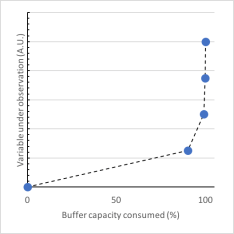
But go back to the initial premise that the atmosphere is a buffer, when will we know that we’ve exceeded the “buffer capacity” for CO2?

buffer example rev00An example of a buffer curve showing the variable
under observation versus percent completion.

And that’s the problem, we don’t know how much of the buffering capacity we’ve consumed, and we probably won’t know where we are on the curve until after we’ve reached a tipping point, and temperatures accelerate beyond the slow, apparently linear trend we observe today.

Why should we fund research? It is investment in individuals that pays off.

What’s the ROI to the nation? A quick, back-of-the-envelope estimation (okay… a quick spreadsheet estimation) shows the internal rate of return to be positive. The short-term cost of supporting graduate students has long term benefits.

image (2)Figure 1. Estimated salary from age 22 to 59 for a hypothetical worker.


image (3)Figure 2. The internal rate of return on supporting a graduate student for six years in this example is 3.6%.

As a democracy, we have a unique opportunity to decide what is important. What “Great” ideas can we as a nation support that as individuals we could never achieve.

Most people today are familiar with an MRI; however, most people do not know the technology is based on Nuclear Magnetic Resonance (NMR). The fundamental physics of NMR was first worked out in the 1930s. Development of the technique continued after World War II, but it wasn’t until 1977 that the first MRI was performed on a person. (https://www.aps.org/publications/apsnews/200607/history.cfm)

That’s a three to four-decade process from lab to commercialization. For every mainstream technology our society uses today, there is a similar story.

How many graduate students worked on projects during the 30+ years of development of the final product? Buried inside the major headlines are thousands of “little” stories. Stories of our nation’s commitment to supporting researchers and their basic research.

Those who pursue advanced degrees in science and engineering – financially supported by our national government – provide the foundation for companies who take an idea to market; industries (semiconductor, pharmaceutical, medical device, energy) aren’t building widgets anymore, they’re building vast databases of knowledge that will result in physical products. The jobs needed to create those physical products will rely on highly automated systems and any tasks that require low skill labor is going to be outsourced or marginalized. As a Democracy, we can support the creation of knowledge and develop skills to improve our quality of life or fall behind countries making that investment. As a bonus, it makes financial sense as well.